
The honest answer
Spray foam does not automatically destroy a roof structure. Roofs are opened up every week and found to be in perfectly serviceable condition underneath.
There is a number attached to this. A Property Care Association and Home Owners Alliance study of spray foam inspections at more than 500 properties found 35% had one or more defect as a result of the foam. That is a serious minority, and it is also a clear majority that did not. Treat it as a reason to check, not a reason to assume the worst.
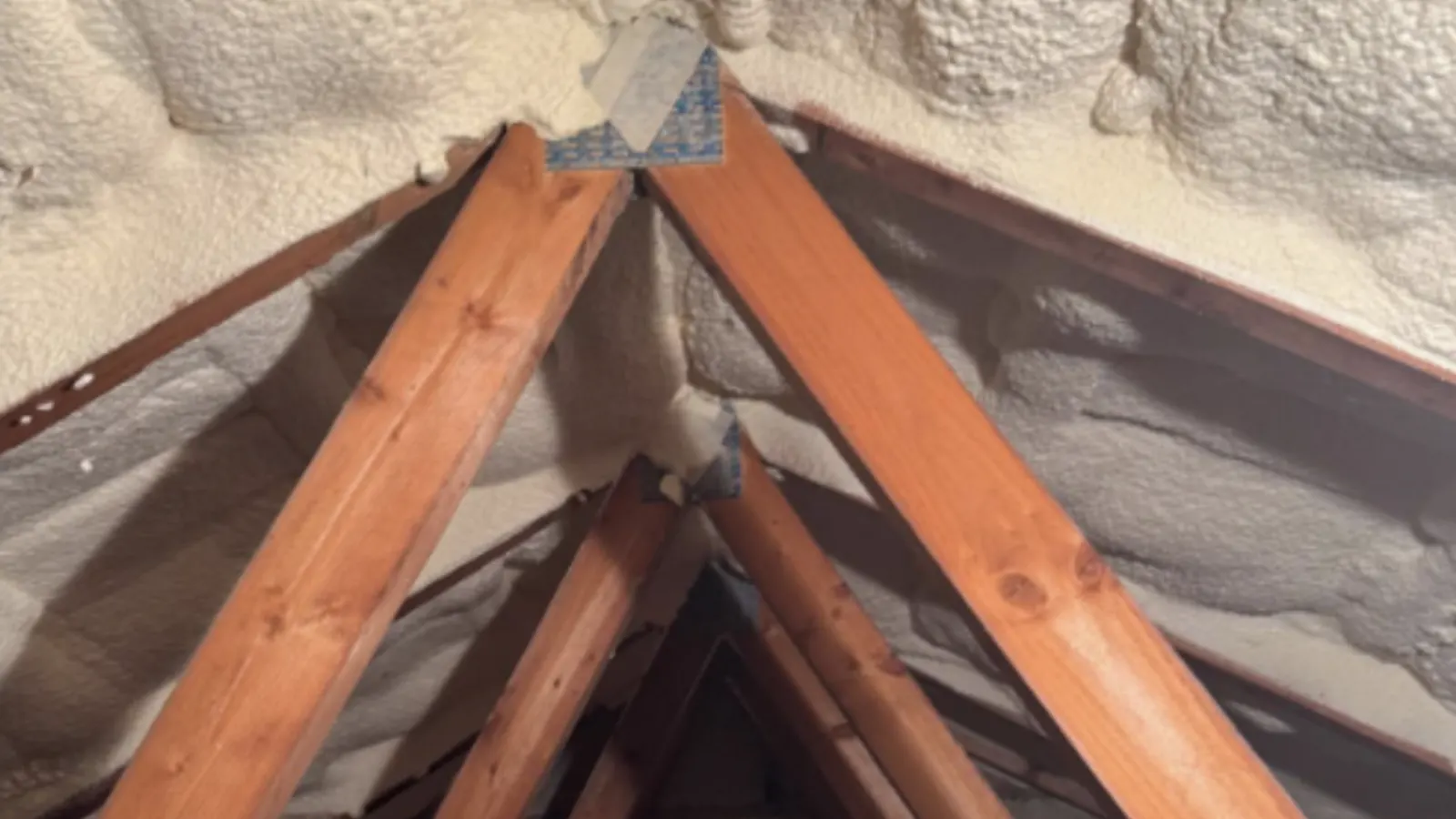
What foam reliably does is two things: it removes the drying mechanism the timbers depended on, and it removes your ability to check the result. The first makes decay possible. The second makes it undetectable until somebody strips the foam off.
The mechanism, briefly
Timber tolerates getting wet. What it does not tolerate is staying wet. A ventilated cold roof lets moisture move away, so timber that gets damp dries out again and nothing happens.
Close that ventilation path and moisture from the house below has nowhere to go. It condenses on cold surfaces inside the roof space, and if it does so against timber that cannot dry, sustained moisture content is what allows decay and fungal growth to start. Our guide to loft condensation covers how the system is meant to work.
The variable is not the foam itself. It is how wet the roof gets, how long it stays wet, and whether anything can dry. Two identical installations in different houses can end very differently.
Why the foam type changes the risk
Open cell foam is vapour permeable. Moisture passes through it and reaches whatever is behind, which may be a cold underlay or the covering itself, and condenses there, out of sight.
Closed cell foam blocks vapour at its face, which sounds like the safer option. The difficulty is that it bonds hard to what it is sprayed on, seals the timber against a surface that cannot dry, and traps anything that does get behind it. Our comparison of open cell and closed cell foam covers how each behaves and what it means for removal.
Signs worth taking seriously
All of these are indirect, because the timber is covered.
- A musty, damp or earthy smell in the loft, which is often the first thing anybody notices
- Staining, darkening or softness on any timber visible at the edges of the foam, at the eaves or around the hatch
- Sagging or dishing between rafters, or a roofline that has started to wave
- Damp patches or staining on upstairs ceilings with no obvious leak above
- Foam that has come away from the timber in places, which may indicate movement or moisture behind it
None of these confirms decay, and their absence does not rule it out. That is the core of the problem.
Why an assessment cannot be done through the foam
There is no reliable way to assess the condition of covered timbers without exposing them. Moisture readings taken through foam do not tell you what the rafter behind it is doing, and a visual inspection of a foamed roof is an inspection of foam.
This is exactly the reasoning surveyors apply, and our guide to spray foam and property surveys covers how it tends to be reported.
What happens when damage is found
Affected rafters and battens are repaired or replaced once exposed, and the roof is reinstated as a ventilated structure so the same thing does not happen again. Ventilating a decayed roof without repairing it does not undo the decay, so the order matters.
Because timber repair is construction work rather than roofing work, this is the point where a removal only contractor has to stop and hand the problem over. Our guide to the removal process step by step sets out where the inspection sits in the sequence, and our spray foam removal service covers removal, inspection, timber repair and re-insulation as one job.