
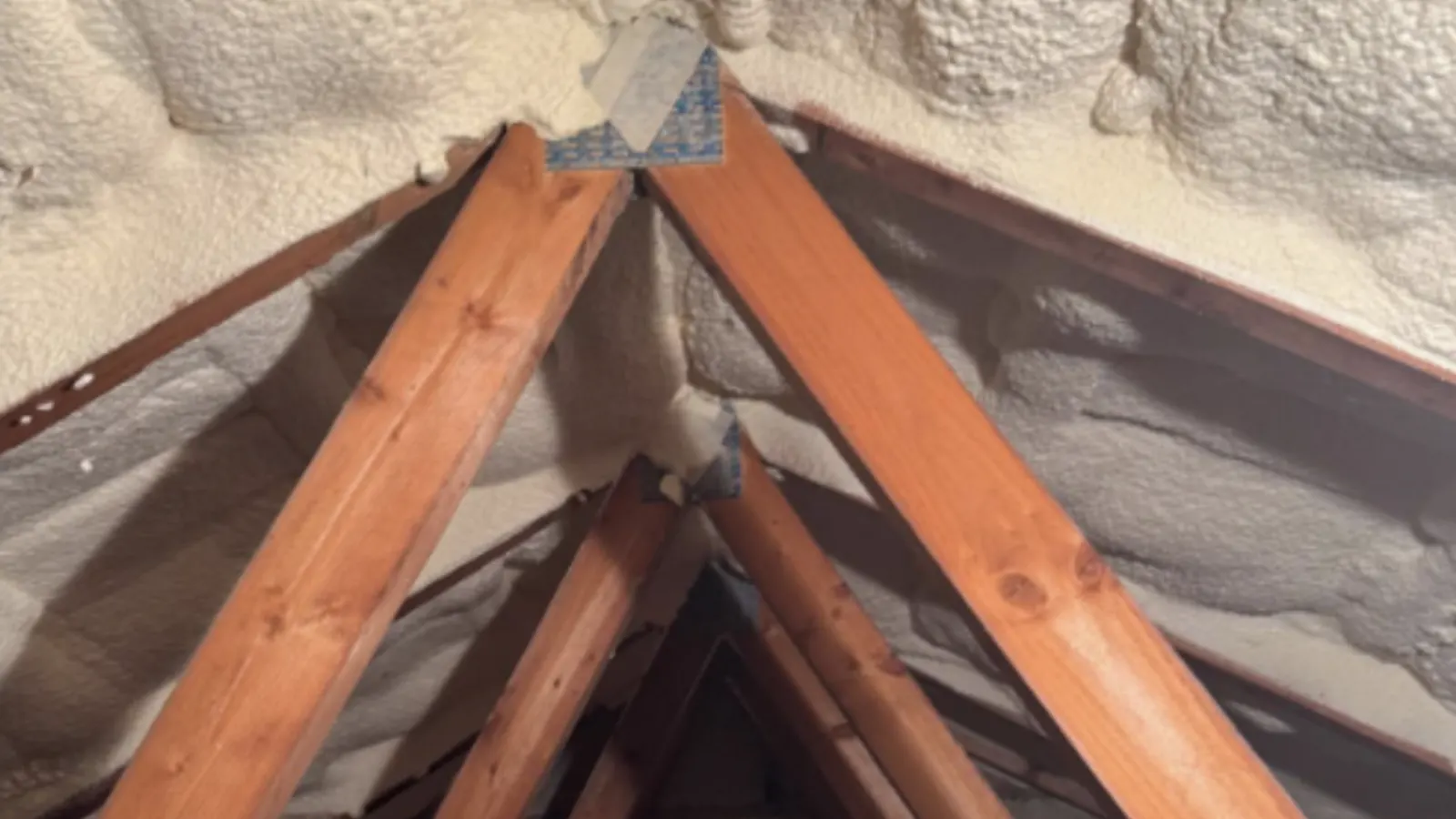
Two products, one appearance
Both types are sprayed as a liquid that expands in place, and both end up as a pale foam covering the underside of a roof. In a dim loft they look much the same. They are not.
- Open cell. Soft, low density, sponge like. The cells are interconnected, so it is vapour permeable to a degree. Press it and it gives.
- Closed cell. Rigid, higher density, board like. The cells are sealed, so it acts as a vapour barrier. Press it and nothing happens.
The simplest field test is finger pressure. Soft and springy is open cell. Hard and unyielding is closed cell. Where the foam has been overpainted or is very thin, it is worth having it looked at rather than guessed.
Why the type changes the removal
Open cell
Generally the more straightforward of the two. It is softer, and where it was applied over an intact underlay it can usually be cut and stripped back without taking the underlay with it. It still has to come off completely, because leaving a residual layer keeps the inspection problem in place.
Closed cell
The harder case. It bonds strongly, and it is the type most often sprayed directly onto the underside of the covering with no ventilated gap. Where that has happened, separating foam from tile or slate without damaging the covering frequently is not possible, and the honest answer is that part of the roof has to be re-covered.
This is the single biggest reason removal quotes vary so widely, which our guide to spray foam removal cost covers in more detail.
What each one does to the roof space
A traditional pitched roof relies on ventilation to carry moisture away. Both foam types applied to the underside of the roof interfere with that, but differently.
Open cell lets vapour through. If it reaches a cold surface behind the foam and there is no airflow, it condenses where nobody can see it. Closed cell blocks vapour at the foam face, which sounds better, but it also seals the timbers against a surface that cannot dry, and any moisture that does get behind it stays there.
In both cases the outcome is the same for a surveyor: the rafters, battens and underlay cannot be inspected. Our guide to loft condensation covers how a ventilated roof is meant to work.
What this means for a survey or a sale
Lenders and surveyors are not objecting to insulation. They are objecting to not being able to see the roof structure. Which foam type you have affects how likely underlying damage is, but it does not remove the visibility problem, and that is what drives the caution.
If you are mid sale or mid purchase, our guides to spray foam and mortgages and selling a house with spray foam cover each side of that conversation. Policies vary between lenders and change over time, so nobody can promise a particular lending outcome either way.
What a proper removal covers
- Identifying the foam type and how it was applied before quoting
- Complete removal rather than a partial strip back
- Inspection of the rafters, battens and underlay once they are exposed
- Timber repair or replacement where the inspection finds it is needed
- Reinstating ventilation and re-insulating correctly, usually at ceiling level
- A photographic and written record of what was found and what was done
That last point is what a surveyor actually wants to see afterwards, and our guide to the paperwork lenders and surveyors want sets out what should be in the pack. Because we are a construction company, timber repair found during the inspection is part of the same job rather than a reason to stop. Our spray foam removal service covers this nationwide.