
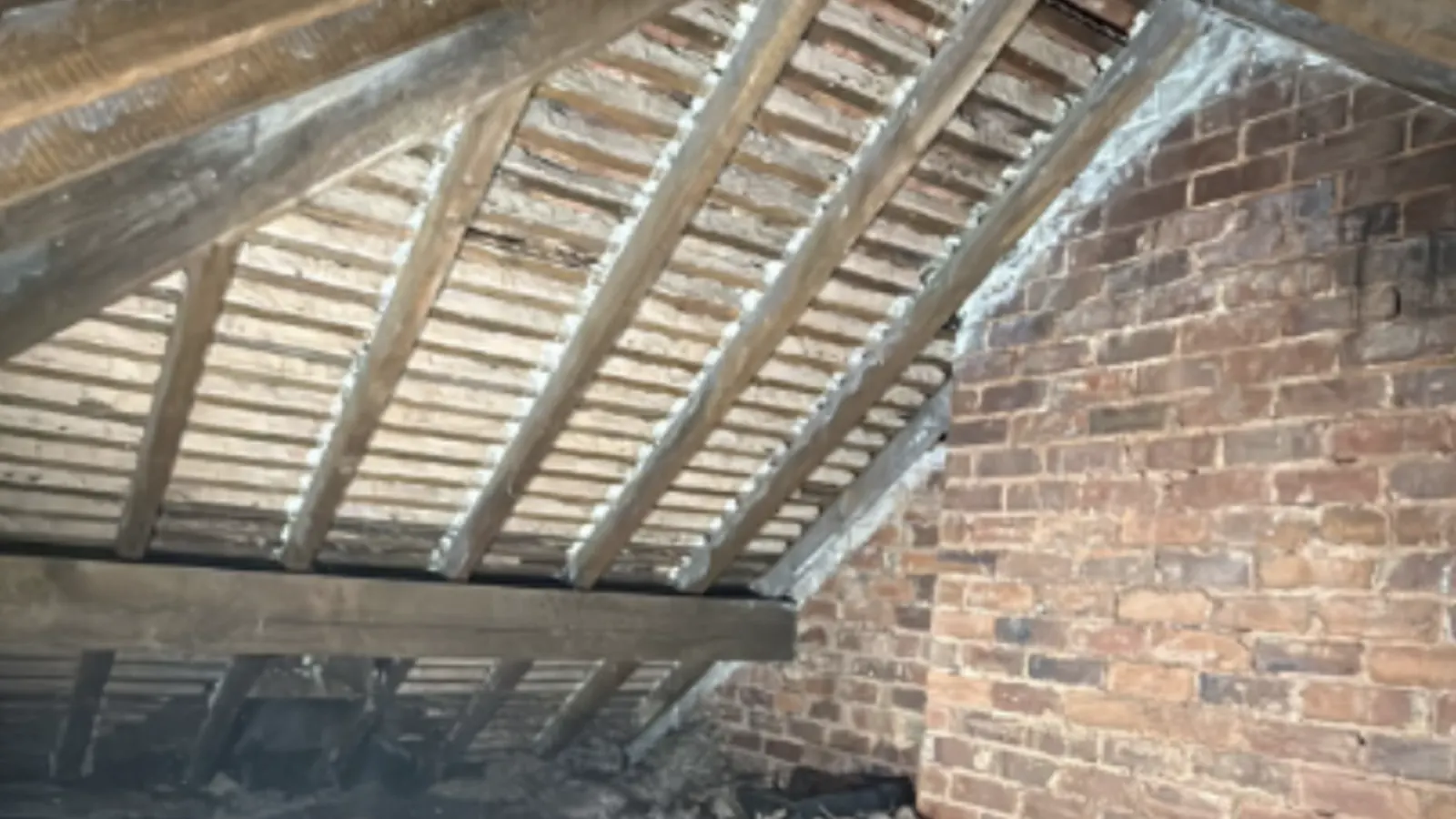
What condensation in a loft actually is
Warm air from the house carries moisture. Cooking, washing, drying clothes and breathing all add to it. That air rises, finds its way into the roof space through gaps around loft hatches, downlights, pipe runs and cable holes, and meets a cold surface. The moisture drops out as water.
The surface it meets is usually the underside of the roof covering or the underlay, which is why the drips look exactly like a leak.
A traditional pitched roof is designed to be cold and ventilated. Air moves in at the eaves and out at the ridge, and that airflow carries the moisture away. When the airflow stops, the moisture stays.
How to tell it apart from a leak
- Timing. Condensation is worst after cold, still nights. A leak follows rain, and particularly wind driven rain from one direction.
- Spread. Condensation appears evenly across the whole underside of the roof. A leak is localised and traceable to a point.
- Nail points. Droplets forming on the tips of nails coming through the underlay are a classic condensation signature.
- Staining. A leak leaves a run mark and usually a tide line. Condensation leaves general darkening and, in time, black mould.
The usual causes
Blocked eaves ventilation
By far the most common. Loft insulation is laid across the ceiling and pushed tight into the eaves, sealing the gap that lets air in. The insulation was upgraded, the ventilation was never checked, and the loft has been damp ever since.
Non breathable underlay
Older bitumen felt does not let vapour through. If the roof relies on eaves and ridge airflow and that airflow is compromised, the felt becomes the cold surface everything condenses on.
Moisture coming up from the house
An uninsulated, unsealed loft hatch, recessed downlights in the ceiling below, or a bathroom extractor fan discharging into the loft rather than through the roof or wall. That last one is common and puts a remarkable amount of water into a roof space.
Spray foam on the underside of the roof
Foam sprayed directly onto the underlay or the covering removes the ventilated void entirely, and it also hides the timbers so nobody can see what the moisture is doing. Our guide to open cell and closed cell foam explains why the two behave differently.
What to check yourself
- Look at the eaves from inside the loft. Can you see daylight or a clear air gap above the insulation?
- Check whether the bathroom and kitchen extractors actually vent outside, not into the roof space
- Check the loft hatch for a seal and insulation
- Look at the timbers for black mould or soft, dark patches, and press them
- Look after a cold night rather than during rain, because that is when condensation shows
What fixing it usually involves
Most cases are resolved by restoring loft ventilation rather than by roofing work: eaves vents or over fascia vents to reopen the intake, ridge or tile vents to give the air somewhere to go, insulation pulled back from the eaves and held clear, extractors ducted properly to the outside, and the loft hatch sealed and insulated.
Where timbers have already been affected, the repair comes first and the ventilation fix second, because ventilating a decayed roof does not undo the decay. That is the point at which being a construction company rather than a roofing only firm matters, since the timber work and the roof work are the same job.
If the damp turns out to be a covering failure rather than condensation, our guide to telling whether a roof needs replacing covers what to look for next. Our insulation service and roofing service both start with a free no obligation survey that includes the roof space.