
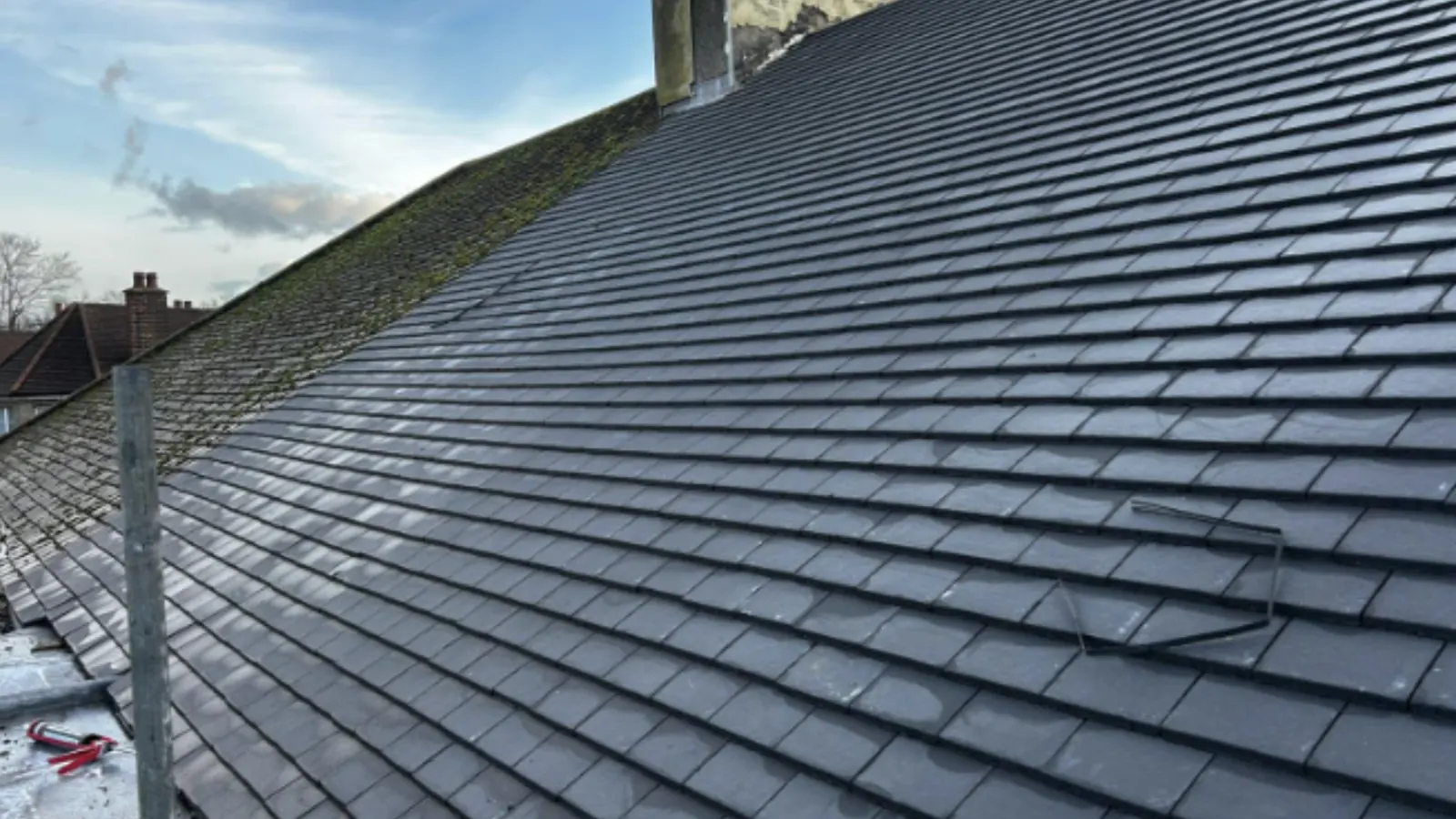
The short answer
A new roof is not usually a value-adding improvement in the way that a well-designed extension or a loft conversion is. Those add floor space, and floor space is what valuers price. A roof does not add a square metre to your home.
What a roof does is different, and in a slow market it can matter more. A sound roof removes a problem. A failing roof creates one, and problems get priced into offers far more aggressively than improvements get rewarded.
Put simply: a new roof is more likely to protect the price you were going to get than to lift you above it. Anyone promising you a fixed percentage uplift for a re-roof is guessing.
Why buyers and surveyors react so strongly to roofs
Three things happen when a roof is visibly near the end of its life.
- The survey flags it. A homebuyer survey that mentions roof covering nearing the end of its serviceable life gives the buyer a written reason to renegotiate, and they will usually ask for more than the job actually costs.
- The lender may get involved. Where a survey raises significant concern, a lender can retain part of the advance until work is done, which stalls the sale at the worst possible moment.
- Buyers overestimate the cost. Most people have no idea what a re-roof costs. Faced with uncertainty, they assume the worst and discount accordingly.
That last point is the one homeowners underestimate. A buyer knocking an arbitrary amount off because "it needs a new roof at some point" is common, and the number they pick is rarely generous.
When replacing the roof is worth doing before you sell
Replacing a roof purely to sell is often the wrong call financially. It is usually worth it when:
- There is active water ingress, because damage compounds and starts affecting timber, plaster and decoration
- The covering is visibly failing across the whole roof rather than in one area, so a repair only delays the conversation
- A survey has already flagged it and the sale is stalling on that point
- You are staying put for several more years and will get the use out of it yourself
It is usually not worth it when the roof has years of life left and you are replacing it speculatively in the hope of a higher asking price. In that case you are spending real money for an uncertain, and usually smaller, return.
Repair, recover or replace
These are three different jobs with very different costs, and firms that only do one of them have an obvious incentive to recommend it.
Repair
Right where the covering is broadly sound and the failure is localised: slipped tiles, a failed flashing, a section of ridge. Cheapest, and often the correct answer.
Recover
Stripping the covering and relaying with new felt, battens and tiles while keeping the existing structure. Appropriate where the timbers are sound.
Full replacement
Needed where the structure itself has suffered, commonly from long-term water ingress or from insulation that has trapped moisture against the timbers.
This is where being a construction company rather than a roofing-only firm changes the advice. A roofing-only firm can strip and relay. If the timbers underneath turn out to be the problem, someone has to be able to repair or replace them.
Does a new roof lower your home insurance?
Sometimes, but do not count on it as a reason to do the work. Insurers price on many factors, and while a recently replaced roof can help, the saving rarely justifies the job on its own. Treat any reduction as a bonus rather than part of the business case.
What to do before you spend anything
Get the roof looked at properly, in person, by someone who is willing to tell you it does not need replacing. An assessment should tell you which of the three jobs above you are actually facing and roughly how long the current covering has left.
If someone quotes a full re-roof without going up to look, or without inspecting the roof space from inside, that is not an assessment. That is a price list.