
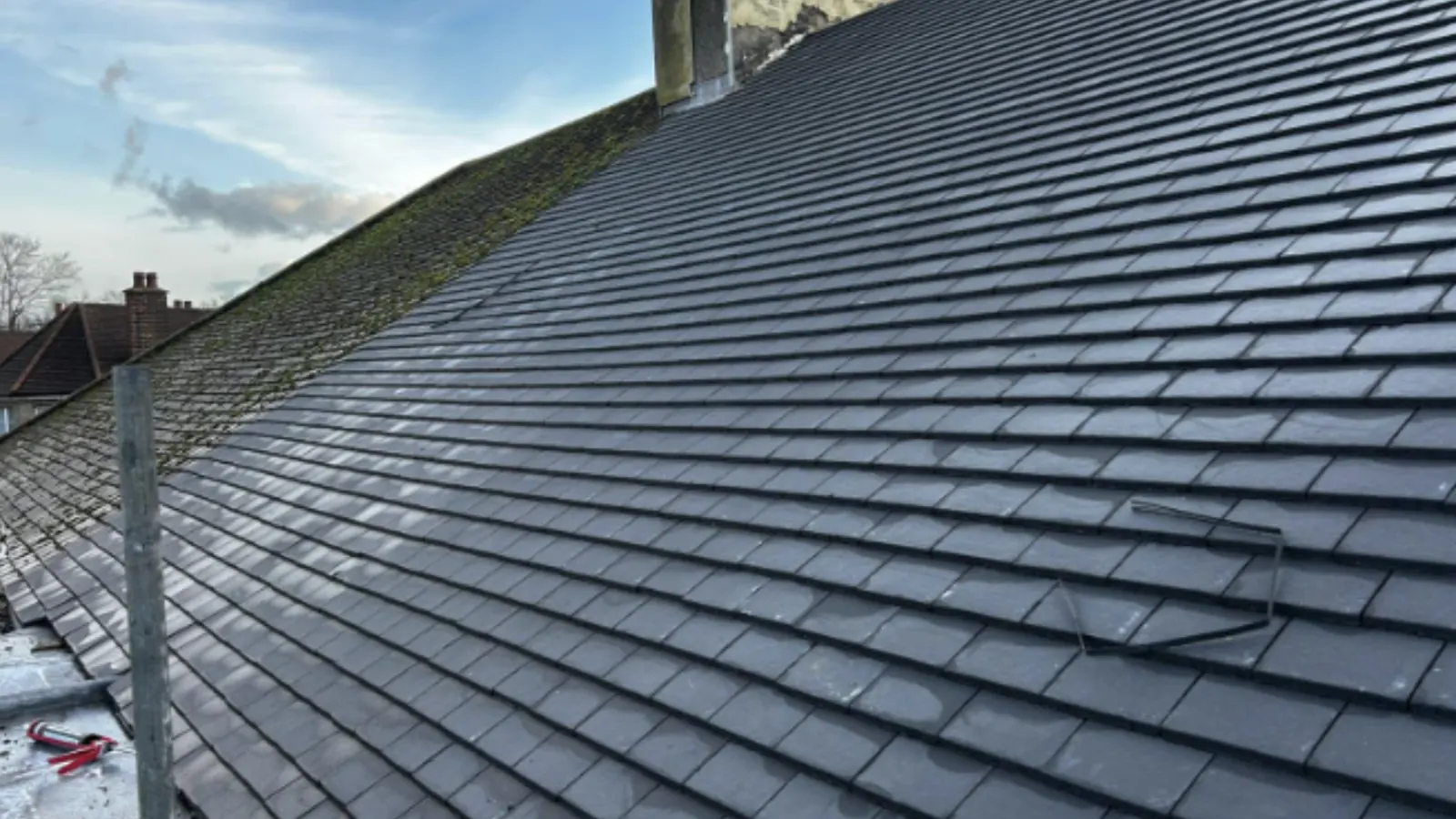
Why there is no single number
A re-roof is priced from the specific roof, not from a table. Two houses of the same footprint can differ substantially in roof replacement cost because one has a simple gable roof and the other has hips, valleys, two chimneys and a conservatory in the way.
We do not publish headline prices, for a reason. A figure that looks attractive online is only ever achieved by leaving something out of the scope, and the thing left out reappears later as a variation.
The only figure that means anything is a written, itemised quote produced after somebody has been up to the roof and inside the roof space.
What moves the price
Roof size and shape
Area is the starting point, but complexity often matters more. Hips, valleys, dormers, chimneys and abutments all need detailing and flashing, and detailing is slow work.
Covering material
Concrete tile, clay tile and natural slate sit at very different points, and the difference compounds because heavier or more expensive coverings also change the labour and sometimes the structure.
Access and scaffolding
A detached house with clear ground on four sides is straightforward. A terrace with rear access through a neighbouring garden, or a pavement scaffold needing a council licence, is not. This is frequently the difference between two quotes.
Timber condition found on the strip
Nobody knows what is under the covering until it comes off. Rafters, battens and the wall plate can all need attention, and where water has been getting in for years, they usually do.
Dry fix requirements
Current practice moves ridges, hips and verges away from mortar bedding to mechanically fixed dry systems. On an older roof this is often new work rather than like for like replacement.
This is a standards requirement, not an upsell. BS 5534, the code of practice for slating and tiling, was amended so that mortar can no longer be relied on as the only means of securing a roof covering: ridge and hip tiles must be mechanically fixed even where they are mortar bedded, and dry fix systems are covered by BS 8612. If a quote for an older roof says nothing about how the ridge and verge are fixed, ask.
Underlay, insulation and ventilation
A strip and relay is the natural moment to correct a roof that has never ventilated properly. It is cheap while the covering is off and expensive afterwards.
Waste and disposal
An old concrete tile roof produces a great deal of heavy waste, and skip and tip costs are a real line item rather than a rounding error.
What should be on the quote
- The covering specified by manufacturer and product, not just "tiles"
- Underlay and batten specification
- Whether ridge, hip and verge are dry fixed or bedded
- Scaffolding, access and any licence, stated as included or excluded
- Flashings, chimneys, valleys and any leadwork
- Gutter, fascia and soffit work if it forms part of the job
- Waste removal
- A stated rate for timber replacement found during the strip
- The written guarantee and what it covers
If a quote is a single line and a total, you cannot compare it with anything, and neither can we.
Repair, recover or replace
Before the cost question is worth asking, the scope question needs answering. A localised failure is a repair. A sound structure under a worn covering is a strip and relay. A structure that has taken years of water is a bigger job. Our guide to whether your roof needs replacing covers how to tell, and what is included in a full re-roof sets out the scope in detail.
Being a construction company rather than a roofing only firm changes what we can recommend here. If the timbers are the problem, we can repair them. A contractor who only strips and relays has one answer available.
Before you commit
Get more than one quote, insist all of them are itemised, and compare the scope before the totals. Ask each firm what happens if the timbers are worse than expected, and get the answer in writing. Our roofing service starts with a free no obligation survey, including the roof space, and you get a written itemised price rather than a headline figure.